

Trade Waste and DWT: Why a Booking System is Your Biggest Compliance Asset

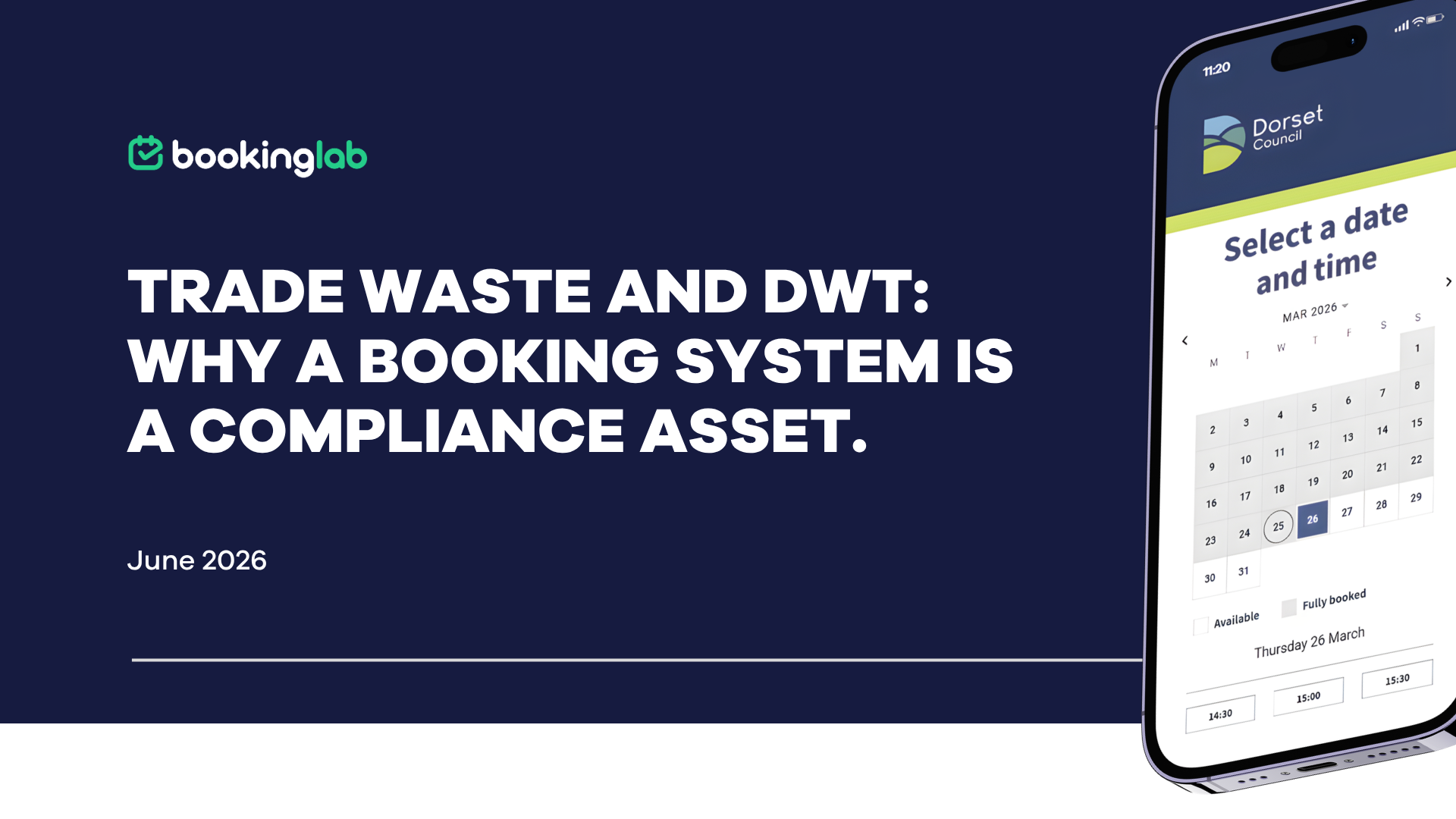
Everyone knows what a booking system can do for residential HWRC visits: manage demand, cut costs, reduce misuse. That part of the conversation is well-established. But the relationship between permits, bookings and trade waste is a different story, and one the sector hasn't talked about nearly enough. With Digital Waste Tracking legislation moving closer to full rollout, the case for bringing trade waste into a booking system has never been stronger.
The trade waste ecosystem
Managing trade waste at an HWRC involves a lot of moving parts. Permits need issuing, validating, monitoring and renewing. Vehicles need checking on arrival, something on-site check-in apps (and ANPR) have transformed. Bookings need to be tied to permit records. And for sites with weighbridge infrastructure, the whole process needs to connect through, from the moment a trader books a slot to the final weight being recorded and charged.
A booking system built for this environment doesn't just handle demand. It ties permits, ANPR, bookings and weighbridge integration into a single, joined-up workflow. Traders are easily validated. Staff spend less time on manual checks. The site runs more efficiently, and the data is there when you need it.
Digital waste tracking: what's coming and why it matters
Digital Waste Tracking (DWT) legislation is rolling out in two phases, and both have relevance for how HWRCs manage trade waste.
Phase 1 becomes mandatory in October 2026, requiring HWRC operators in England to record details of all commercial waste received into permitted sites on the government's Digital Waste Tracking Service. The obligation sits with the operator rather than the trader, but it's a good opportunity to get processes in place. Sites already running a trade waste booking scheme will find themselves well placed, with the data they need captured at the point of booking.
Phase 2 is where it gets interesting. From October 2027, the requirement extends to waste collectors, carriers, brokers and dealers, meaning traders themselves will have a compliance obligation to record their own waste movements digitally. That changes the conversation entirely. A booking process that prompts traders to supply vehicle details, waste classifications and descriptions before they arrive doesn't just help the HWRC run more smoothly. It gives traders a ready-made record of their own movements, making compliance simpler for everyone in the chain.
The operational case
Think about what happens today at a trade waste HWRC without a booking system in place. A trader arrives, permit details are checked manually against paper-based records, usage is tracked on spreadsheets or not at all, staff take details by hand, and paper forms get completed on-site with weights noted at the weighbridge. Every step in that chain is a potential bottleneck, an error, or a data blind spot.
Now consider the alternative. The trader books in advance, they've supplied waste classification details and vehicle information at the point of booking. On arrival, ANPR or a check-in app confirms their booking and permit automatically, with every visit logged against their permit record in real time. The weighbridge records the load, and the data flows directly into the digital waste tracking submission. No tailbacks at the gate. No form-filling on-site.
That's not a speculative future. It's what a well-integrated permits, booking and weighbridge system delivers today, and it puts operators in a strong position ahead of both phases of the DWT rollout.
The cost-benefit picture
The efficiency gains are tangible. Faster throughput means more slots and better revenue yield per day. Pre-captured waste data reduces staff time at the point of arrival and simplifies the record-keeping that digital waste tracking will require. Permit management overheads drop significantly too, with automatic approvals, self-service renewals and trader-managed updates removing the back-and-forth that consumes staff time under a manual scheme. For councils already managing trade waste permit schemes, bringing bookings into the same system closes the loop on a process that currently relies too heavily on manual intervention at each stage.
Come and hear more at NCAS
With the October 2026 Phase 1 deadline approaching and Phase 2 on the horizon, now is the time for HWRC operators to get the right processes in place. We'll be delivering a talk on this topic at NCAS this year, covering the full trade waste booking ecosystem and what operators should be doing to prepare.
If you're not attending NCAS, you don't have to miss out. Fill in this form and we'll send you a copy of the deck after the event.


