
Is It Time to Rethink Your Registrars and Ceremonies Booking System?
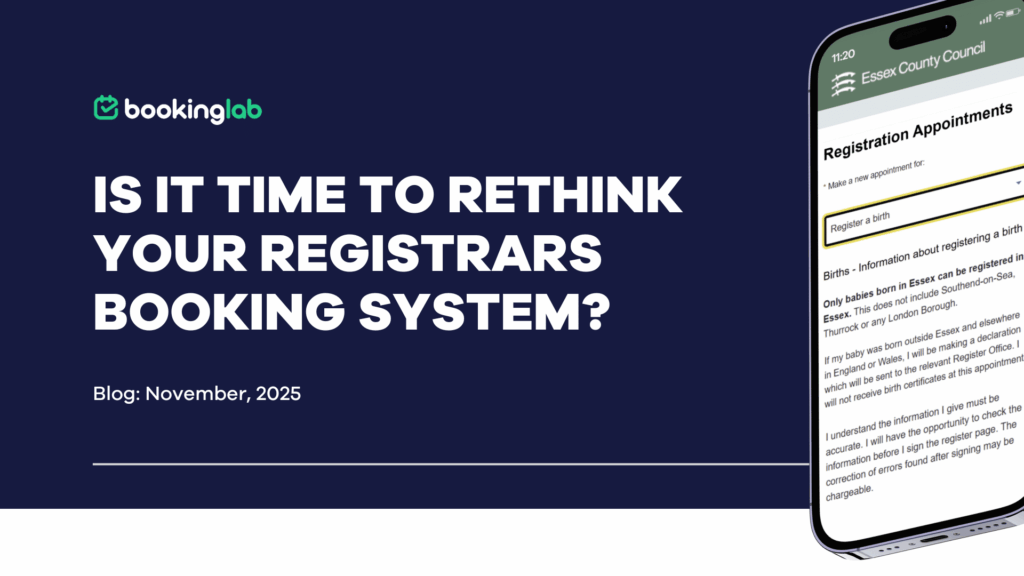
We’ve heard it over and over: registration services are being held back by rigid, outdated booking systems.
At LARCSA 2025, that message came through loud and clear. Legacy software isn’t just slowing processes, it’s holding back progress.
Staff are working harder than ever to meet demand, but manual, time-consuming tasks continue to drain time and hold back efficiency.
Staff are working harder than ever to meet demand, but manual, time-consuming tasks continue to drain time and hold back efficiency. Staff are working harder than ever to meet demand, but manual, time-consuming tasks continue to drain time and hold back efficiency.
Residents face clunky, impersonal journeys, limited availability, and a user experience that no longer meets modern expectations.
As expectations rise, the gap between what’s needed and what’s possible keeps growing.
If that sounds familiar, it’s time for a change.
Because the right platform doesn’t just replace ageing tech, it redefines how your service works. It brings automation where it’s needed most, removes friction, and gives residents (and staff) the seamless flexibility they expect. It frees your team to focus on what really matters: supporting people through life’s key moments.
While statutory, ceremony, and citizenship services share many of the same challenges, each has its own path to modernisation.
In this blog, we’ll focus on the statutory side, looking at where legacy systems fall short and how we’ve solved those challenges.
The next two instalments will look at ceremonies and citizenships in turn.
Why Most Legacy Booking Systems Fall Short
Legacy systems weren’t built for the demands of today’s registration services.
Most haven’t evolved to reflect advances in technology, rising customer expectations, or the growing complexity of modern service delivery.
The result? Inefficient processes, frustrated teams, and services that can’t scale or adapt as needs change.
Limited capability
Automation is minimal, if it exists at all. Business rules and workflows are basic, offering little flexibility to reflect the nuances of different services. Appointment allocation isn’t intelligently optimised around key inputs such as service type, duration, location, or additional requirements. The result? Underused capacity, inefficient scheduling, and fewer available appointments.
Poor user experience
Rigid, disconnected workflows turn even simple tasks into obstacles. Staff can’t easily update important booking information or adjust the system to meet changing needs. For residents, the experience feels dated and unintuitive. Forms don’t adapt to their responses or offer guidance, creating friction on both sides.
Manual workarounds
Teams spend hours manually adjusting schedules, juggling spreadsheets, and enforcing compliance. Tasks that should be automated, like staff allocation, appointment durations, and information management, are still managed manually. Time that could be spent on service delivery is lost to admin.
Inflexible policies
Hardcoded rules make adapting to local processes or policy changes virtually impossible. Updates to messaging, service details, or local business rules either can’t be made or demand costly development work. Meeting organisation-specific KPIs beyond statutory requirements becomes out of reach. Instead of driving progress, the system blocks it, limiting flexibility and holding teams back.
Lack of reporting and insight
Most legacy systems offer only basic reporting. Teams lack real-time visibility of performance, trends, and demand, making it difficult to plan resources effectively or evidence service improvements.
Inefficient workforce management
Tracking staff availability, assigning appointments, and managing rotas are often still handled manually. It’s time-consuming, adds unnecessary admin, and increases the risk of error. With rules-based automation, these tasks can run automatically at set intervals, ensuring fairer distribution, optimised capacity, and a balanced workload.
Limited certificate management
Errors are common, reconciliation is slow, and visibility is limited. Without support for complex fee models or prioritisation rules, managing fulfilment becomes another administrative burden.
Restricted self-service
Many legacy systems can’t support complex or multi-service bookings online. Residents are forced to call or email when they’d rather book, amend, or manage their appointments digitally. This drives up contact volumes, slows response times, and undermines the efficiency gains that true self-service should deliver. Phone support will always have its place, but it shouldn’t be the only option.
These aren’t just minor frustrations. They are barriers that quietly undermine service quality, drain resources, and slow innovation.
When systems can’t keep up, talented teams are forced to work around their tools instead of being empowered by them.
And for residents, the experience suffers. Rigid processes and limited choice make simple interactions harder than they should be.
Modern registration services deserve better. They need platforms built for flexibility, not workarounds. Systems that evolve with changing needs, streamline complexity, and empower teams to deliver consistently excellent service.
With that in mind, here’s how our system solves the challenges faced by modern registration services.
How Our System Solves These Challenges
Technology that simplifies complexity
Our system adapts to your service, not the other way around. Advanced business logic and configurable workflows handle even the most complex scenarios, ensuring smooth and efficient processes. Appointment allocation is automatically optimised based on factors like service type, location, and staff availability, helping you maximise capacity and reduce wasted time.
Modern, intuitive user experience
We’ve reimagined the booking experience for both staff and residents. Workflows are clear, responsive, and designed to adapt in real time. Staff can update information easily, while appointment complexities are managed automatically. Residents benefit from a guided journey that adjusts to their inputs, minimises errors, and delivers a seamless experience from start to finish.
Purpose-built automation
Automation replaces repetitive admin so your team can focus on what matters. Staff allocation, appointment durations, fee calculations, and notifications all run automatically in the background. Compliance checks and process rules are built in, reducing errors and freeing teams from time-consuming manual work.
Flexible by design
We don’t believe in a one-size-fits-all approach. Every council operates differently, and their system should reflect that. Service rules, workflows, and messaging can be configured to align with local processes and priorities. Messaging and booking questions can be updated instantly in-house through an intuitive admin portal. Councils can respond quickly to new legislation, adapt to local needs, and align with organisation-specific KPIs without technical barriers. The system evolves with your service, not against it.
Real-time insight and reporting
Live dashboards provide a complete view of performance, demand, and capacity. Custom filters, data exports, and visual insights make it easy to monitor trends, ensure compliance, and evidence improvement. No more digging through spreadsheets to find what you need.
Smarter workforce management
Our system supports multiple ways of working. Councils can choose a traditional setup or take a more automated approach, where staff rotas, appointment allocation, and availability tracking run seamlessly through configurable rules. The system fills gaps intelligently, updates availability in real time, and removes the need for manual scheduling, helping teams operate at full capacity.
Streamlined certificate management
Certificate ordering, tracking, and automated reconciliation are built into the platform. Support for complex fee models, prioritisation rules, and full audit trails keeps processes accurate, transparent, and efficient. Teams can fulfil orders faster, monitor performance in real time, and remove manual steps with multi-basket ordering.
True self-service for every scenario
Complex multi-resource and multi-service bookings can be managed entirely online. Residents choose their preferred channel and complete their journey without waiting for staff support. This saves time, reduces pressure on contact centres, and improves satisfaction. For those who prefer to call, staff have end-to-end visibility of every booking and access to guided workflows, ensuring a consistent, connected experience across all channels.
How?
We’ve worked closely with registration teams across the country, from smaller services to some of the largest, to uncover what really holds them back. We listened, learned, and built a system around the realities of their work. Every feature has a purpose. Every workflow removes friction, saves time, and makes life easier for the people who use it every day.
Want to learn more?
See our market-leading Registrars Booking System in action. Click here to book a demo.
Is It Time to Rethink Your Registrars and Ceremonies Booking System?
We’ve heard it over and over: registration services are being held back by rigid, outdated…
The RWM Expo 2025
Event Roundup: RWM 2025
HWRC Community News
HWRC Community News – October 2025 Momentum continues to build across our HWRC community. It’s…
// PHP code goes here